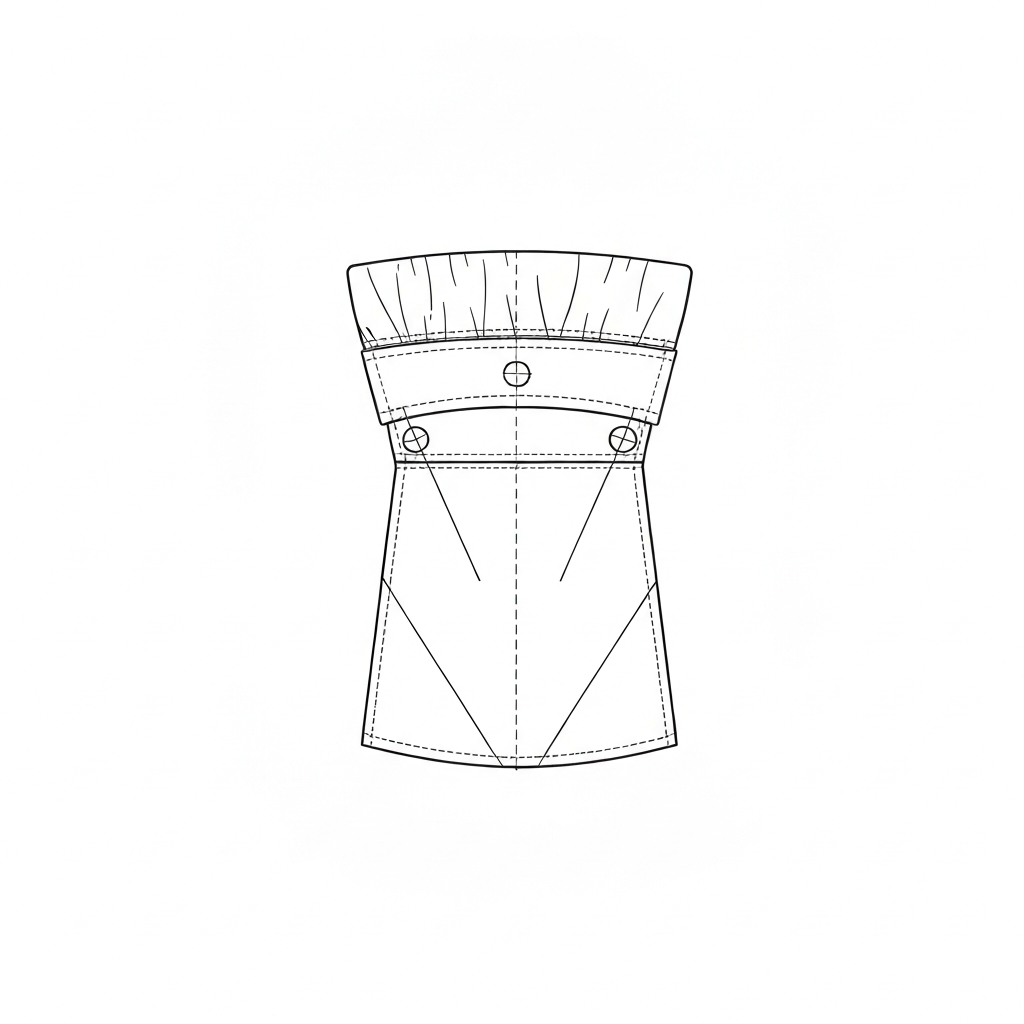
 Figure 1: Angled Cuff structure and Topstitching details of a typical dress shirt
¶ 1. Definition and Overview
A Cuff is an independent fabric component attached to the sleeve opening of a top or coat to finish, reinforce, and decorate the sleeve. In Korean garment manufacturing sites, the elastic finish of knit materials is sometimes referred to as 'Sibori', but the technical standard term is unified as Cuff. Functionally, it provides convenience for the wearer through the opening and closing of the sleeve and fixes the silhouette around the wrist. Physically, it acts as a sacrificial reinforcement to prevent wear and tear at the sleeve ends, where external friction is most frequent.
From a sewing engineering perspective, a cuff is a 'structural termination device' that converges the wide lower circumference of the sleeve panel to fit the narrow wrist circumference. The excess volume (Ease) generated during this process is secured inside the cuff through tucks, shirring, or ease adjustment. It is primarily based on the lockstitch (ISO 301), and the process of inserting an adhesive interlining coated with thermoplastic resin is essential to ensure shape stability and rigidity. Modern garment manufacturing encompasses not only woven shirt cuffs but also knit cuffs (Rib) for knitwear and adjustable Velcro cuffs for outerwear.
 Figure 2: Industrial cuff application examples (Left: Dress shirt, Right: Workwear adjustable cuff)
¶ 2. Technical Specifications
| Item | Detailed Specifications | Remarks |
|---|---|---|
| Stitch Classification (ISO 4915) | Class 301 (Lockstitch), Class 401 (Chain), Class 406 (Cover) | Used interchangeably depending on purpose |
| Seam Classification (ISO 4916) | Seam Type 1.01.01, 2.04.03, 6.02.01 | Depends on cuff attachment and topstitching method |
| Major Sewing Machine Types | High-speed single-needle lockstitcher, Automatic cuff indexer, Automatic cuff setter | Juki, Brother, Jack, Durkopp Adler |
| Recommended Models | Juki DDL-9000C, Brother S-7300A, Juki UAB-1351 (Automatic) | Digital Feed recommended |
| Needle System | DB×1, DP×5 (#9 ~ #16) | Selected based on fabric thickness and density |
| Needle Point Type | SPI (Sharp), SES (Light Ball), SUK (Medium Ball) | Selected based on knit/woven characteristics |
| Standard SPI (Stitches Per Inch) | 10 ~ 18 SPI (Dress shirts), 7 ~ 12 SPI (Workwear) | Higher SPI required for high-density fabrics |
| Thread Specifications | Core Spun 40/2, 60/2, 80/2 | Optimized for fabric shrinkage and strength |
| Max Sewing Speed | 3,500 ~ 5,000 spm | Observe upper limit when operating automated equipment |
| Interlining Specifications | PA/PES resin adhesive interlining (Woven/Non-woven) | Requires 130°C~160°C, 2~4kg/cm² pressing |
| Bobbin Thread Tension (Towa) | 20 ~ 30 gf (Shirts), 35 ~ 50 gf (Outerwear) | Based on digital tension gauge measurement |
| Presser Foot Pressure | 1.5 ~ 3.0 kgf | To prevent fabric shifting and feed puckering |
¶ 3. Major Types and Structural Classification of Cuffs
- Barrel Cuff: The most common single-layer structure, secured with buttons. It is subdivided by corner shape as follows:
- Square: Right-angle finish. Mainly used for casual shirts.
- Round: Curved finish. Provides low friction resistance and a soft impression.
- Angled/Mitered: Finished with a 45-degree angle. The standard for formal shirts.
- French Cuff: A double-layered structure where the sleeve length is made twice as long, folded back, and secured with cufflinks. Used for formal evening wear.
- Convertible Cuff: A versatile structure with buttonholes on both sides so that either buttons or cufflinks can be used.
- Ribbed Cuff: A method of attaching a 1x1 or 2x2 rib knit fabric in a cylindrical shape to fit closely to the wrist. Elasticity and recovery are key. (Korean field term: Sibori)
- Adjustable/Tab Cuff: A functional structure that allows free adjustment of the wrist circumference using Velcro, snap buttons, or tabs.
¶ 4. Industrial Applications and Detailed Specifications
- Formal Wear:
- Core Specs: High-density lockstitch of 14–18 SPI. 1/16" (approx. 1.6mm) edge stitch applied.
- Technical Point: There must be no bubbling during interlining fusing, and the curvature of the left and right cuffs must be perfectly symmetrical.
- Casual/Activewear:
- Core Specs: ISO 504 (Overlock) and ISO 406 (Coverstitch) used in combination.
- Technical Point: Differential feed values must be precisely set to prevent 'waving' caused by the feed difference between the rib fabric and the body panel.
- Outerwear:
- Core Specs: 8–10 SPI. Use of #14–#16 needles and 30/3 thick thread.
- Technical Point: For waterproof fabrics, seam sealing tape treatment may be performed to prevent leakage through needle holes.
- Workwear/Military:
- Core Specs: High-strength nylon thread and bartack reinforcement.
- Technical Point: When using flame-resistant (FR) fabrics, Aramid sewing thread and dedicated interlining must be used.
¶ 5. Major Defects and Advanced Troubleshooting
| Defect Name | Cause | Solution |
|---|---|---|
| Puckering | Excessive thread tension, mismatch in fabric/interlining shrinkage, improper feed dog height | Relax needle thread tension, use low-shrinkage thread, synchronize top and bottom feed with digital feed system. |
| Twisting | Imbalance in top/bottom fabric feed, misalignment of grain line | Use a walking foot, strictly follow grain line during cutting, optimize presser foot pressure. |
| Corner Burst | Insufficient seam allowance trimming when turning, needle point damage (burr) | Precisely trim seam allowance at a 45-degree angle, use a dedicated turning jig, replace needles periodically. |
| Bubbling | Insufficient fusing temperature/pressure, poor resin coating, delamination after washing | Measure actual press temperature (thermo-sensitive tape), check pressure uniformity, follow optimal bonding condition charts per fabric. |
| Asymmetry | Cutting error, failure to use sewing guides, variation in operator skill | Use dedicated cuff templates, introduce automatic cuff setters, utilize compensating foot guides. |
| Bird's Nest | Poor bobbin thread management at start, excessive thread tail after trimming | Enable wiper function, check automatic thread trimmer tension release, set 'Slow Start'. |
| Ease Mismatch | Calculation error between sleeve panel and cuff circumference | Review tech pack specifications, apply fabric holding techniques in front of the presser foot during sewing. |
| Stitch Run-off | High-speed sewing on curved sections, unbalanced presser foot pressure | Decelerate when entering curves (pedal control), use a 1/16" compensating foot. |
| Needle Holes | Excessive needle size, thick needle relative to fabric density | Downsize needle to #9~#11, ensure fiber flexibility through fabric humidification. |
| Fraying | Insufficient buttonhole stitch density, worn knife blade | Increase stitch density, replace knife blade and check cutting pressure. |
| Shine/Moire | Excessive pressing temperature and pressure, failure to use pressing cloth | Lower pressing temperature by 10–20°C, attach Teflon sheets, adjust steam injection volume. |
| Bobbin Breakage | Excessive bobbin case spring tension, damaged bobbin | Clean and replace bobbin case, reset bobbin thread tension to around 25gf (Towa). |
¶ 6. Quality Control Standards (QC Standard & AQL)
- Dimensional Accuracy: The length and width of the finished cuff must be within ±2mm of the Tech Pack (based on AQL 2.5).
- Symmetry: When the left and right sleeves are placed together, the shape, stitch line starting points, and button/buttonhole positions must align horizontally.
- Stitch Quality: There must be no skipped stitches in curved sections, and the topstitching line must maintain a constant distance (e.g., 1/16") from the edge.
- Bonding Strength: During a peel test after interlining fusing, a minimum strength of 500g/5cm must be maintained, and there should be no lifting even after 5 washes.
- Appearance Finish: 100% inspection for shine caused by pressing, thermal discoloration, and remaining thread ends.
¶ 7. Global Factory Slang and Terminology Dictionary
| Category | Term | Meaning & Remarks |
|---|---|---|
| Korea (KR) | 시보리 | 니트 소재의 신축성 있는 커프스 (일본어 '시보루' 유래) |
| Korea (KR) | 이세 (Ease) | 입체감을 위해 소매 분량을 커프스에 밀어 넣는 기술 |
| Korea (KR) | 다마 (Dama) | 커프스 끝단의 둥근 곡선 처리 (일본어 '타마' 유래) |
| Korea (KR) | 켄사키 (Kensaki) | 커프스나 견보로의 뾰족한 끝부분 |
| Japan (JP) | カフス (Kafusu) | Cuff의 일본식 표기 |
| Japan (JP) | 袖口 (Sodeguchi) | 소매 끝단 전체를 지칭하는 기술 용어 |
| Vietnam (VN) | Cổ tay áo | 일반적인 셔츠 커프스 |
| Vietnam (VN) | Bo tay | 니트 커프스(시보리) 형태의 커프스 |
| China (CN) | 袖口 (Xiùkǒu) | 소매 입구 및 커프스 통칭 |
| China (CN) | 介英 (Gaiying) | 광동/홍콩 지역 공장에서 사용하는 커프스 은어 |
| English (EN) | Placket | 커프스 위쪽의 소매 트임 부위 (견보로) |
¶ 8. Equipment Setting and Maintenance Guide
- Fusing Press: Check the belt for contamination daily and verify heat plate uniformity through a 3-point temperature test (left, center, right). Standard settings: 140°C, 3kg/cm², 12 seconds.
- Presser Foot: Use a 1/16" or 1/8" compensating foot for consistent topstitching, and check the bottom surface for wear to prevent fabric scratches.
- Feed Dog: Use 4-row fine teeth for thin fabrics and 3-row coarse teeth for thick fabrics, with height set at 0.8–1.0mm.
- Needle Cooling Device: Operate silicone oil tanks or air cooling systems during high-speed sewing to prevent synthetic fibers from melting.
- Automatic Cuff Setter (Juki AP-876): Inspect the wear of the folding jig weekly and ensure vacuum suction pressure is sufficient to hold the fabric.
¶ 9. Process Flowchart
¶ 10. Regional Production Strategies and Field Know-how
¶ 10.1 Korea (High-End & Detail)
Skilled Korean workers excel in ease adjustment, often referred to as 'Son-mat' (hand-feel). Especially in high-end menswear processes, they employ '3D sewing' techniques where the inner cuff fabric is sewn 1–2mm smaller than the outer fabric, causing the cuff to naturally curve toward the wrist when worn. Additionally, for 'Dama (curve)' processing, they prefer hand-turning the fabric rather than using ready-made jigs to create unique curvatures.
¶ 10.2 Vietnam (Mass Production & Automation)
Large vendors in Vietnam (Hansae, Sae-A, etc.) maximize productivity by utilizing automatic cuff indexers like the Juki UAB-1351. The operator only handles fabric supply, while the machine automatically performs folding, sewing, and stacking. Since the precision of the jig determines 90% of the quality, focus is placed on managing dedicated CNC-machined jigs. In terms of line balancing, the cuff process is prone to becoming a bottleneck, so it has the highest ratio of automation.
¶ 10.3 China (Supply Chain Integration)
Chinese factories take advantage of the proximity between fabric production and sewing to reduce process steps by using 'interlining-integrated fabrics' or 'pre-processed cuffs'. They are also actively adopting smart factory solutions that use laser cutters to control cuff corner errors in 0.1mm increments. Factories in the Guangdong region use the slang 'Gaiying', and the collaboration system between specialized small-scale factories is extremely fast.
¶ 11. Advanced Field Troubleshooting Manual
- Flaring (Cuff ends turning outward):
- Diagnosis: Tension imbalance between the top and bottom layers or excessive interlining shrinkage.
- Remedy: Pull the inner fabric by about 3% during sewing, or add a 24-hour aging process after interlining fusing.
- Stitch Run-off:
- Diagnosis: Fabric shifting during rotation due to insufficient presser foot pressure.
- Remedy: Reduce sewing machine speed by 30% in curved sections and replace with a high-friction Teflon foot.
- Delamination after washing:
- Diagnosis: Failure to reach resin melting temperature or compatibility issues with fabric water-repellent coating.
- Remedy: Change resin type from PA (Polyamide) to PES (Polyester), or consider pre-treatment to remove water repellent from the fabric before bonding.
- Bulkiness at the cuff connection:
- Diagnosis: Error in seam allowance overlap design.
- Remedy: Grade the seam allowance at the point where it meets the placket, and if necessary, perform hammering or high-pressure pressing on that specific area.
- Ease Clumping:
- Diagnosis: Excess sleeve volume concentrated in one spot.
- Remedy: Before attaching the cuff, perform two rows of basting on the lower sleeve to distribute gathers uniformly before final lockstitching.
¶ 12. Comparison of Alternative Techniques and Materials
| Comparison Item | Traditional Sewn Cuff | Seamless Welding Cuff | Laser-cut Finish Cuff |
|---|---|---|---|
| Key Features | Structure using stitches and interlining | Ultrasonic/Thermal compression bonding | Exposed edge after laser cutting |
| Pros | High durability and easy repair | Excellent comfort due to no seams, perfectly waterproof | Simplified process, modern design |
| Cons | Many process steps, requires high skill | Expensive equipment required, risk of delamination | Risk of edge fraying (limited to synthetic fibers) |
| Applications | Dress shirts, suits, coats | Functional outdoor, cycling wear | Minimalism design, experimental clothing |
¶ 13. Recommended Sewing Settings by Material
- Silk/Chiffon: Needle #7~#9, SPI 18~22, Bobbin tension 15~20gf. Use of tissue paper backing recommended.
- Denim (12~14oz): Needle #16~#19, SPI 8~10, Bobbin tension 50~60gf. Use of Core Spun 20/3 thread.
- Functional Stretch (4-way Stretch): SES point needle, SPI 12~14, Differential feed set to 1.2~1.5 to prevent stretching.
¶ 14. Related Items
- Sleeve Placket: The component that finishes the sleeve opening above the cuff.
- Interlining: A key sub-material for maintaining the strength and shape of the cuff.
- Tuck/Pleats: Folds made to fit the sleeve's excess volume into the cuff width.
- Topstitching: Stitches sewn on the surface for exterior decoration and securing seam allowances.
- Differential Feed: A mechanical setting to prevent fabric stretching when sewing knit cuffs.
- Bartack: Reinforcement sewing to prevent tearing at the end of the cuff opening (ISO 304).
- AQL (Acceptable Quality Level): A statistical indicator of allowable defect levels in mass production.
- Ease: A sewing technique of finely pushing in fabric to make a flat piece three-dimensional.