¶ 1. Definition and Core Mechanism
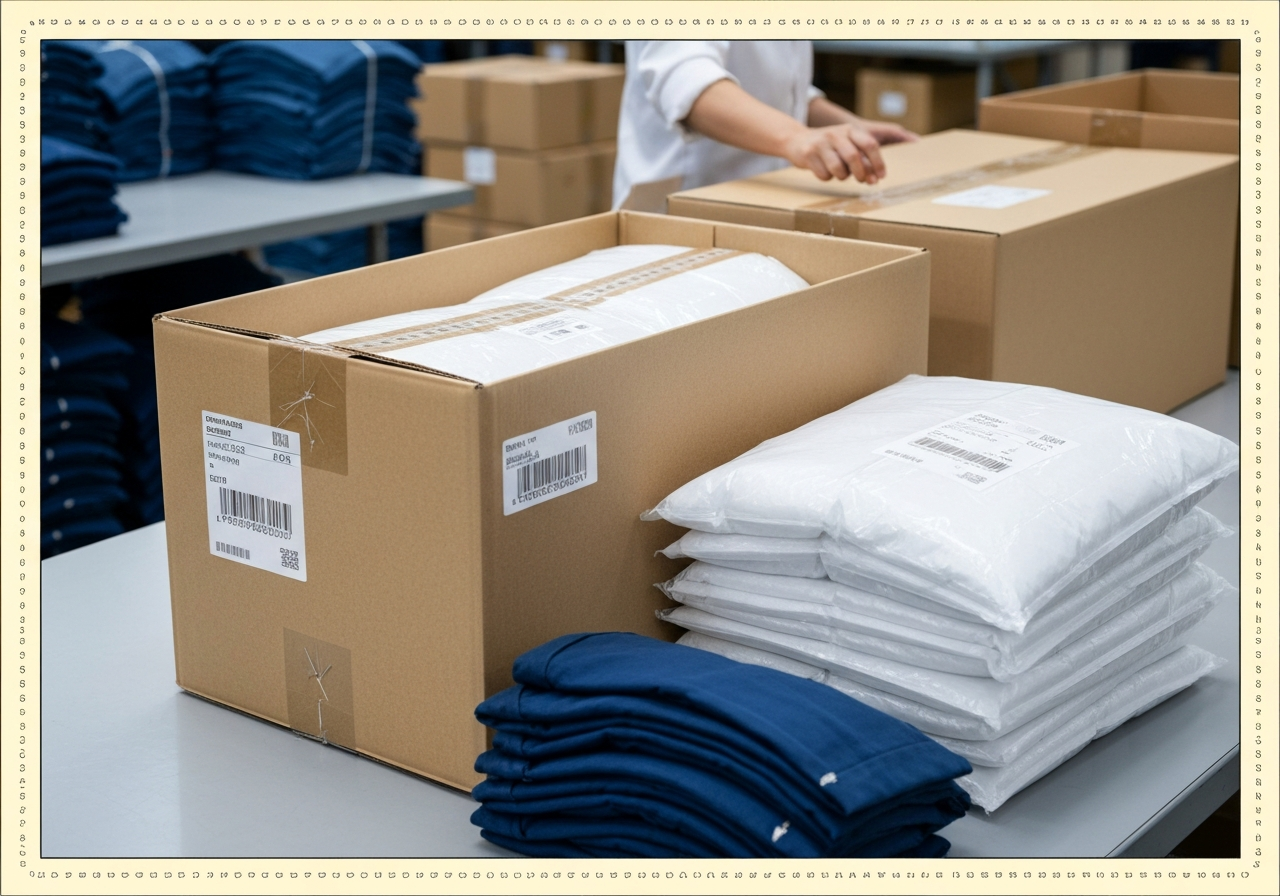
A Master Carton is a high-strength corrugated cardboard box used in the final logistics stage of the sewing and garment manufacturing industry to consolidate finished products—which have already undergone individual packaging (Inner Box) or polybagging—into units for shipment and storage. Beyond being a simple packaging material, it is a critical technical device within the Global Supply Chain (SCM) that preserves the quality of internal products (shape retention, contamination prevention) against physical impacts, high-humidity environments, and multi-tier stacking loads encountered during sea and air transport.
From a garment factory operations perspective, the master carton is the final "protective shield" that products pass through after clearing Final Inspection and Finishing (Shiage) before leaving the factory. In terms of physical mechanisms, the master carton acts as a structural pillar resisting Vertical Compression Loads; the "Flute," which is the medium of the corrugated board, forms a Truss structure to distribute the load stacked on top to the side walls. Unlike Bale Packing used for low-end products, this is an essential standard technique for maintaining the Shape Retention of high-value items such as suits, bags, and footwear. Securing compression strength according to ISO 12048 is a prerequisite for shipping approval from global buyers and serves as a key indicator for evaluating a factory's logistics management capabilities.
¶ 2. Technical Specifications and Material Standards
The performance of a master carton is determined by the combination of the liner's basis weight (grammage) and the flute type. The main specifications used in sewing production sites are as follows:
| Item | Detailed Specifications and Technical Standards | Related Standards and Verification |
|---|---|---|
| Material Classification | Corrugated Fiberboard (Liner combinations: K, SK, S, B, W, etc.) | K: Kraft (175~220g/㎡), S: Testliner (120g/㎡) |
| Flute Type | A (4.5~5mm), B (2.5~3mm), C (3.5~4mm), BC (Double Wall, 6~7mm) | ISO 3037 (ECT measurement standard) |
| Strength Measurement | ECT (Edge Crush Test), Mullen Test (Bursting Strength) | ASTM D5112, ISO 2759 |
| Standard Structure | RSC (Regular Slotted Container) - FEFCO 0201 Code | FEFCO (European Federation of Corrugated Board Manufacturers) |
| Joining Method | Stitching (Stapling), Gluing, Taping | Stitching interval 50~75mm, 45-degree angle recommended |
| Related Standards | ISO 12048 (Compression test), ISO 2233 (Conditioning), ASTM D1974 | ISTA 1A/2A (Linked to transport simulation) |
| Printing Method | Flexo Printing (Water-based), Silk Screen (Special marks) | Water-based ink drying and rub resistance tests mandatory |
| Stacking Load | Compliance with buyer manuals (Typically 15kg ~ 25kg, Max < 30kg) | Prevention of musculoskeletal disorders and box collapse |
| Moisture Content | 8% ~ 12% (At time of dispatch) | Compression strength drops by over 50% if moisture exceeds 15% |
| Liner Combination Example | DW (Double Wall): K210/S120/K175/S120/K210 | Core of total basis weight and strength design (Export standard) |
¶ 3. Applications and Packaging Methods
In sewing factories, master carton input methods are strictly categorized based on product characteristics.
- Apparel
- Solid Color / Solid Size: Single SKU configuration. Highest efficiency for warehouse stacking and inventory auditing.
- Assorted Packing (Pre-pack): Mixing multiple sizes or colors. Configured so retailers can display products immediately after opening the box.
- GOH (Garment on Hanger): Metal or plastic hanger bars are installed at the top of the box. Used for products like coats and suits where maintaining the pressed state is essential. Side wall strength must be more than twice that of standard boxes.
- Bags & Accessories
- Inner Box Integration: Products are placed in individual inner boxes before being loaded into the master carton to preserve the bag's shape.
- Stuffing: Filling the inside of the bag with tissue paper or air caps to support the compression forces generated during master carton stacking from the inside.
- Footwear
- Shoe Box Case: Individual shoe boxes are bundled in units of 10~12 pairs. If gaps occur between boxes, inner boxes may be damaged due to shaking during transport; therefore, "Tight Fit" dimensional design is key.
- Industrial Materials Transport
- Heavy materials such as YKK zippers, metal buttons, and labels may use Triple Wall corrugated board with very high Bursting Strength (BST).
¶ 4. Major Defect Types and Technical Solutions (Troubleshooting)
- Bursting / Side Wall Failure
- Cause: Content density is too high, or low-grade liners with low Mullen Test values are used. Impact from dropping during transport.
- Solution: Change from Single Wall (SW) to Double Wall (DW). Increase Bursting Strength (BST) to at least 12kgf/cm². Apply "L-Taping" to reinforce box corners.
- Moisture & Mold
- Cause: Condensation inside containers during sea transport (Container Sweat). High initial moisture content in high-temperature, high-humidity regions like Vietnam and Indonesia.
- Solution: Add a PE Liner (inner plastic bag) of 0.05mm or thicker inside the box. Insert appropriate specifications of Silica Gel or Anti-mold Stickers. Verify moisture content is below 10% using a high-frequency moisture meter before dispatch.
- Crushing / Buckling
- Cause: Insufficient ECT (Edge Crush Test) strength. Fatigue accumulation in bottom boxes during long-term warehouse stacking. Pallet overhang.
- Solution: Select K-grade liners with high ECT values. Use Interlocking patterns during palletizing to distribute the load. Strictly maintain vertical flute orientation during box design.
- Shipping Mark & Barcode Error
- Cause: Contamination of printing plates, smudging of water-based ink, or barcode failing to meet ANSI grades.
- Solution: Use a barcode verifier to ensure Grade B or higher. Perform 1:1 cross-check against the Master Layout before printing.
- Tape Peeling
- Cause: Reduced adhesion due to dust in the factory. Use of low-cost OPP tape.
- Solution: Use rubber-based hot-melt tape. Apply H-Taping (sealing the center and both sides) to block air ingress.
¶ 5. Quality Control Standards
Senior QCs must inspect master cartons according to the following criteria:
- Appearance and Printing Inspection: Check legibility, position, and typos in the Shipping Mark. Apply AQL 1.5 (Major), 4.0 (Minor) standards. Printing smudges exceeding 3mm are considered defects.
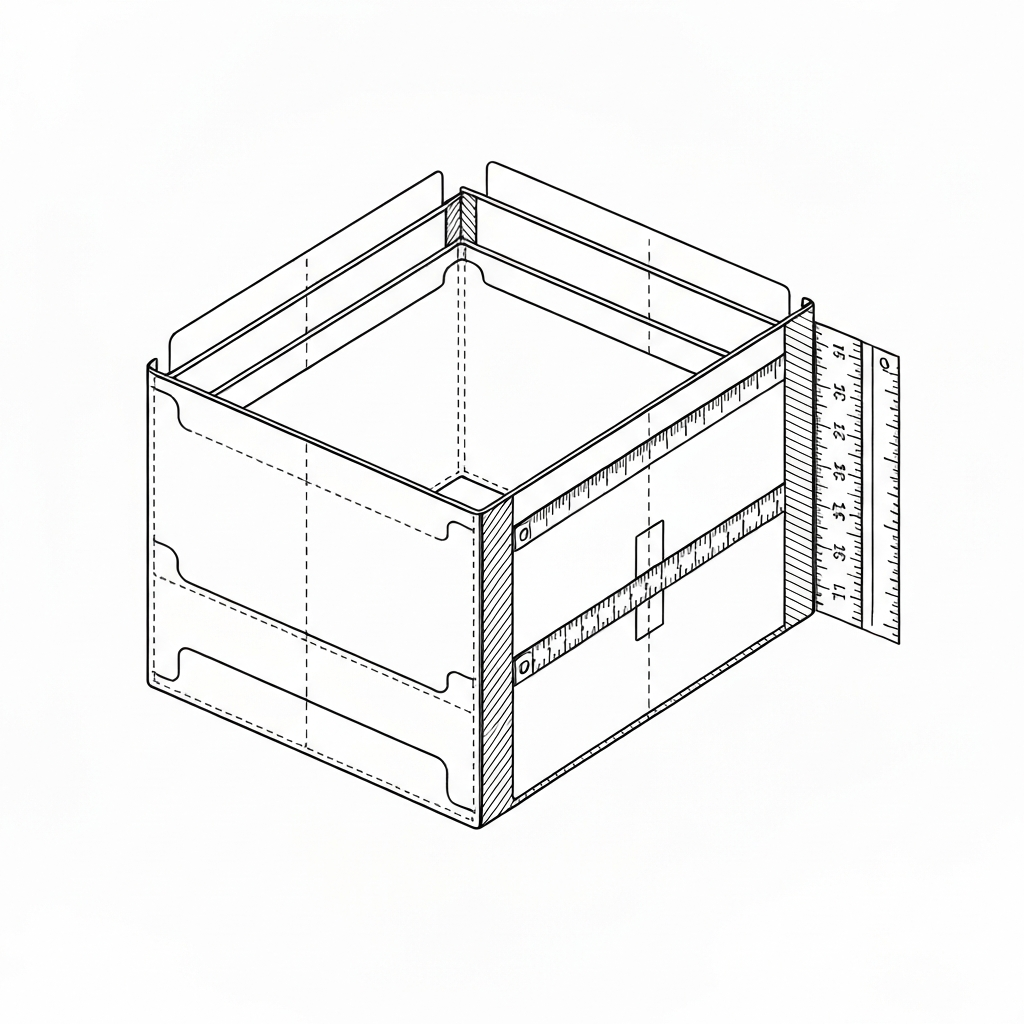
- Dimension Check: Verify that external dimensions (L x W x H) are within ±3mm of the specification. This directly impacts container loading efficiency (CBM).
- Gross Weight: Use precision scales to verify that the actual total weight matches the packing list (allowance of ±0.3kg or ±2%).
- Drop Test: Based on ISTA 1A standards, perform a drop test from a height determined by product weight (e.g., 76cm for under 15kg) following the 1-corner, 3-edge, 6-face sequence, then check the condition of contents and the box.
- Bursting Strength and ECT Test: Regularly sample and test using Mullen Testers and ECT Testers to ensure design specifications (e.g., BST 10kgf/cm², ECT 8kN/m) are met.
- Moisture Measurement: Use a high-frequency moisture meter to ensure moisture content on the box surface and interior is 12% or less.
¶ 6. Field Terminology
These are terms used to increase communication efficiency on the sewing factory floor.
| Language | Term | Romanization | Remarks |
|---|---|---|---|
| 한국어 (KR) | 마스터카톤 | Master Carton | 공식 명칭 및 현장 공용어 |
| 한국어 (KR) | 겉박스 / 수출박스 | Geot-box | 내박스(Inner)와 대비되는 표현 |
| 한국어 (KR) | 시아게 박스 | Shi-a-ge Box | 최종 마무리(시아게) 후 포장하는 박스 |
| 한국어 (KR) | 가미 | Gami | 종이(Paper)를 뜻하는 일본어 잔재, 박스 두께 지칭 시 사용 |
| 일본어 (JP) | 外箱 | Sotobako | 일본 바이어(Uniqlo 등) 대응 시 표준 용어 |
| 일본어 (JP) | 段ボール | Danboru | 골판지 상자 자체를 지칭하는 일반어 |
| 베트남어 (VN) | Thùng ngoài | Thung ngoai | 베트남 현지 공장 관리 용어 |
| 베트남어 (VN) | Thùng Carton | Thung Carton | 카톤 박스 일반 지칭 |
| 중국어 (CN) | 外箱 | Wàixiāng | 중국 현지 공장 및 물류 용어 |
| 중국어 (CN) | 纸箱 | Zhǐxiāng | 종이 박스를 통칭 |
| 영어 (EN) | Shipper | Shipper | 물류 현장에서 외박스를 지칭하는 별칭 |
¶ 7. Equipment Setting and Process Management Guide
- Carton Sealer Adjustment: Set the top head pressure to 2.5~3.5kgf/cm² according to the box height. If pressure is too high, the top flutes of the box will be crushed, reducing ECT strength.
- Strapping Machine: Set PP band tension to approximately 15kgf. For heavy cargo, always insert Edge Protectors before strapping to prevent box damage. Maintain the sealing heater temperature at 290℃.
- Warehouse Environment Management: Maintain humidity below 60% and temperature around 25℃. When palletizing, keep at least 10cm clearance from the ground (Plastic Pallets recommended).
- Stacking Limit: Strictly observe the 'Max Stack' value printed on the box exterior. Apply a Safety Factor of 4:1 for sea transport and 3:1 for air transport.
- Pallet Optimization: Prohibit overhang (boxes extending beyond the pallet). An overhang of 2cm reduces compression strength by approximately 15%.
¶ 8. Process Flow Chart
¶ 9. Logistics Optimization and CBM Management Technology
- CBM (Cubic Meter) Calculation: $Width(m) \times Length(m) \times Height(m) = CBM$.
- Example: $0.6 \times 0.4 \times 0.3 = 0.072 CBM$.
- Container Loadability:
- 20ft Container: Actual load approx. 28 CBM (Theoretical 33 CBM).
- 40ft HC Container: Actual load approx. 68 CBM (Theoretical 76 CBM).
- LCL vs FCL Design Differences: LCL (Less than Container Load) cargo faces a higher risk of crushing by other cargo; therefore, ECT standards should be designed 20% higher than for FCL.
- Minimizing Dead Space: If empty space inside the box exceeds 10%, the stacking load is borne 100% by the box walls rather than the product, increasing the risk of collapse. "Right-sizing" to fit the product is the key to reducing logistics costs.
¶ 10. Regional Practice Differences and Know-how (Field Notes)
- Korean Factories: Optimized for high-mix, low-volume production, resulting in a wide variety of box sizes. Highly sensitive to "Gami" (paper) thickness, with high precision in manual taping.
- Vietnam Factories: Developed automation lines for mass production. Since box strength drops sharply during the Rainy Season in central and southern regions, adding a "Moisture Resistant Coating" option during box manufacturing is a key piece of know-how.
- China Factories: Liner grades (A, B, C) are highly segmented; when prices are pushed down, low-grade paper is frequently mixed in. Bursting strength tests must be performed directly upon receipt of materials.
¶ 11. Related Items and Reference Terms
- Inner Box: The primary box protecting 1 piece or a small unit bundle of products.
- Shipping Mark: Identification markings recording destination, PO number, quantity, weight, etc.
- Packing List: A detailed manifest for each box number.
- Edge Protector: L-shaped reinforcement made of high-strength compressed paper.
- Silica Gel: Desiccant for moisture removal.
- BCT (Box Compression Test): Compression strength test for the entire box.
- FSC Certification (Forest Stewardship Council): Certification for using paper produced through sustainable forest management (a recent mandatory requirement for global buyers).
- GRS (Global Recycled Standard): Certification for recycled paper content.